
A Passage To India, More Or Less
or
How I Finally Got There
In 1998 I was a Fulbright Scholar in India. This essay was written long ago, and details my first—but not my last—experience with the bureaucracy of that country. I have written some more on this subject elsewhere on this site.
Dear Dr C_______:
On behalf of the J. William Fulbright Foreign Scholarship Board, I am pleased to inform you that you have been selected for a Fulbright Scholar Award in India during the 1997-98 academic year...
Thus read the first paragraph of a letter from Mr Hoyt Purvis, Chairman of the Board, informing me that a process set in motion a year and a half before was going better than I had expected it would.
In Academia, the peculiar world in which I work, certain things are expected of you. University faculty members are supposed to develop as independent scholars and researchers, and to have ".. .a reputation in their field for professional excellence." One aid in climbing to the top of the Ivory Tower is to have demonstrable "international involvement and recognition," and at Virginia Tech, the large Land Grant University where I work, this is more or less mandatory for middle-ranking faculty members. Those who hope to attain the Nirvana of Tenure, or to advance in the ranks of the Professorate are pretty much obliged, at some point in their careers, to make the case that they're known and respected outside the borders of their own campus.
Some types of recognition are widely regarded more highly than others. One trophy that carries with it a fair amount of prestige, as well as fulfilling that demand for "international" activity, is the Fulbright Fellowship. Now, I recognize my limitations: I'm never going to win a Nobel Prize, having neither the drive nor any desire to do so, to be honest. But a Fulbright? Why not? It seemed to me that a medium-large sized feather in my Academician's war-bonnet would be worth having, and could it hurt? Selection as a Fulbright Scholar isn't a trivial achievement, and while honesty compels me to put it in the second—or perhaps third—tier of academic feats, nevertheless it's very much a prize worth winning. I thought I might have a chance, and so it was that in May of 1996, when an information and orientation session was held on campus, I decided to attend and see what opportunities would present themselves.
The meeting location was a typical university conference room. Surely it's replicated on every campus in America: a large and sparsely-decorated chamber with a few pictures of former Deans and Presidents on the walls; a long scarred mahogany-veneer table, surrounded by battered armchairs, all of them produced in the state prison system's workshops; and dusty boxes stacked in the corners. Boxes of old papers are a common feature of most University conference rooms, especially those that have long been controlled by single departments. They may contain brochures for the department's graduate program, long since outdated; honors theses submitted by former undergraduates who have since reached retirement age; undistributed reprints of faculty publications; or even the original architect's drawings for the building.
They stay there for decades, preserved by departmental administrators with the mindset of squirrels storing nuts away for hard times. No underling or staff member dares throw them out without permission, and no Department Head or Associate Dean is willing to take the time needed to go through the junk and make a decision on what should be kept and what should be tossed. Over time, a sort of stratification takes place, and one can almost trace a department's history in the various layers, the way a geologist reads rock strata.
As such rooms always are, it was stuffy, because the windows didn't open, and it was too early in the year for the Physical Plant Department to be willing to turn on the air conditioning. About 60 people had shown up, all of them, like me, faculty members who had reached the stage in their careers where bagging a fairly prestigious award might make a significant difference in their retirement checks. Each contributed his or her 600 BTU's per hour to the thermal load. and that was not including the Hot Air Quotient.
A trim and efficient woman, a staff member from the Faculty Development Office, ran the show, speaking to us about the program and its requirements, and doling out useful tidbits of advice for writing a successful application with such authority and assurance that I never realized until I asked where she'd done her Fulbright...that she'd never done one herself. She was just paraphrasing the manual the Foundation had sent, given to her when she was dragooned into being the campus-wide Fulbright Program Coordinator. I didn't let this revelation deter me, nor did it lessen the value of her information. After all, one of the talents every real scholar has to cultivate is the ability to deliver facts of which he has no first-hand knowledge, and to do it in such a way as to make it seem that he, personally, is the discoverer of the Fountain of Wisdom. All in all, I admired her technique, which was flawless. Skill at Faking It is really hard to fake, and this lady was a real pro. She was wasted as a staff member; the University should have offered her a faculty appointment.
The Fulbright Program, we were told, seeks to promote international understanding by the exchange of Scholars between countries. The theory is that if one is exposed to another culture, and in turn acts as a "cultural ambassador" from one's own country, mutual understanding of the two nations is enhanced. American Scholars travel abroad to teach and do research in other nations, and members of foreign faculties come to the USA to do the same. Hundreds of countries participate in the program, thanks to the generosity of the US taxpayer. Over many years that the Fulbright program has been in operation, tens of thousands of such exchanges have taken place. Perhaps 700 or so Fulbrighters are selected from American applicants each year, and a similar number from the other participating nations.
Scanning through the stack of literature Ms Efficient handed out to us, it became obvious that the program is heavily weighted towards the humanities, with only a fairly small percentage of slots allocated to the scientific disciplines. I asked about this, and was told that it's deliberate, a matter of Foundation policy; a hard fact of academic life is that scholars in the "hard sciences" and technological disciplines are more likely to have opportunities for international travel than those in English, History, Art, and so forth.
Fellowships are offered by country in "Named Programs" and in "Any Field." A "Named Program" is one in a specific discipline, and located at a specific institution. A brief description is written up in the annual announcement. The latter, the "Any Field" option, is exactly what it sounds like. Anyone who thinks he or she has a bright idea for a cultural exchange opportunity is welcome to apply. As I discovered later, some pretty outré proposals are submitted, and some of them, anyway, get funded.
 A question I got asked a lot during the period between submission of my proposal and my return (for that matter, even after my return) was "Why India?" The fact is that India was a good choice for me, but at the time I applied, my reasons were pragmatic. I'm an anatomist by trade, and for years taught embryology and development in a variety of institutions. There was a Named Program at Mangalore University, entitled "Developmental Biology," which sounded right up my alley; so I thought I would give that a try and see what happened. In the courses I teach, I've made a good deal of use of electronic media to present my lectures, and a couple of years before I'd had a small internal grant to write a laboratory manual to be used by students through the World Wide Web. India is one of the leading producers of computer programmers, and so, I reasoned, with all that computer literacy lying around on the ground it ought to be an ideal environment for the "distance learning" concept. Given this assumption, I also reasoned that since India is a country with an enormous population and an extensive university system, I could pitch distance learning to them as a way to improve the efficiency of that system.
Another reason was that in India the use of English is widespread, and the language of instruction in the universities is English in most cases, especially in the sciences. The many Indians I knew professionally all spoke excellent English, and assured me it would present no barrier that I was totally ignorant of any of the thousands of local languages Indians use. English is as close to a Universal Language as it's possible to find in India, I was told. I'd made a couple of trips to Egypt, where what is alleged to be English is spoken by educated people; but I found that without an escort and interpreter I'd get lost and starve to death in downtown Cairo, let alone anywhere in the countryside. India seemed a logical choice.
Other reasons were rather less detached and more personal. I'd always wanted to visit India, but the price of a plane ticket and a couple of weeks of travel in-country was out of my reach. Finally, I have a close relative who is a US Government employee, living in New Delhi; he's been inviting me for years, and my response was always, "Steve, if I can find someone to pay my way, I'll come," Becoming a Fulbrighter would certainly fulfill that requirement. Those of us who write grants for a living are well aware of the Pragmatic Scholar's Rule: "Never spend your own money when someone else's money is available." A Fulbright to India was a golden opportunity to put that precept into practice.
.png)
India is one of the countries where an American visitor needs a visa. The Fulbright documents had detailed the visa requirernents, and since I was not to go there as a tourist, they were quite specific that I had to have an "entry" visa; a tourist's visa was not acceptable, since I would be working and earning money. I'd been warned that the Indian bureaucracy was pretty slow and that it would be well to do as much as possible in advance of my trip, so once I'd received final approval from the Indian government for my project and passed my physical, I flew up to Washington DC in late July to get my visa, and to complete the paperwork at the Fulbright office. Virginia Tech has a very posh private airplane that they use to ferry people around. It was going to DC with three gentlemen from our Waste Policy Institute, so I rode along. We left Blacksburg's small airport at 8:30 AM, landing at National Airport an hour later, in the flossiest general aviation terminal I have ever seen.
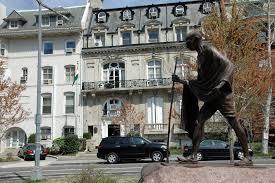 Most foreign embassies are located in stately old mansions in northwest Washington. The Indian Embassy occupies one such building on upper Massachusetts Avenue. From the street it looks rather imposing, but inside it has been re-done in the Institutional Ugly School, with drab grey walls and cheap but sturdy office furniture. The consular section, where you get visas, is in the basement. They are open for business from 9:30 to 12:30 so I was well in time, arriving about 10:45 or so. The basement room was small and packed with people; it was staffed by one harassed, tired, and moderately rude clerk behind the wicket. I filled out the forms and stood in line, and then when my turn came, told them I was there to get an entry visa, as I was to go to India as a Fulbright Scholar.
I was under the impression that the words "Fulbright Scholar " would set me apart in the clerk's eyes as not just another in the common herd of applicants for tourist visas, but I was wrong. Apparently these words are in Chinese, not English, because they made no impression whatever. It's possible the clerk had never heard them before, since he looked at me blankly. I repeated the information, laying stress on the information that I was not going as a tourist, and eventually this much at least sank in. He looked at my forms and my passport, and said, "You will have to ___________.” The last word was totally unintelligible, but it was clear that he wanted me to fill out some more forms.
I told him, "Sir, I have been filling out forms for this visa since last November. I've had a research clearance issued; here's a copy of the letter from the Ministry of Human Resources Development authorizing my visit. Here's a copy of my medical clearance. Here is a letter informing me that all formalities have been completed, and that I should go and get my visa. Somewhere in this building is a file with my name on it about an inch thick, that has been growing steadily larger over the past eight months. If you will please go and find it, you'll find everything you need in it."
This presented him with a situation for which he had no training. The three standardized answers he'd been taught to give to all questions didn't suffice, so he fell back to the emergency answer, "I don't know anything about that." He went to the back and fetched another clerk. This one, obviously the senior of the two, was a grumpy late-middle-aged man whose command of English was substantially less than the original clerk's. This man stared at my papers for a few seconds and then told me he would give me a "research visa." I showed him the letter from the Indian Fulbright office that plainly stated I was enter the country on an "entry visa" and told him about my file. He smiled softly to himself with the knowing air of a bureaucrat who has a supplicant for official approval right where he wants him. "There are a lot of files in this building," was his answer, "and we can't go looking for it."
At that point, I managed to control my temper, but needed some further advice. I went to the telephone and called my contact at the Fulbright office. He suggested I get in touch with the Cultural and Educational office of the Embassy. I went upstairs to the main section of the building to find it. There I was met by a fierce-looking receptionist: a middle-aged woman in a sari whose job, apparently, was to buzz the security lock on the door if she was reasonably sure whoever rang it isn't a Tamil Tiger terrorist.
After admission, her plain duty was to glare balefully at the visitor and demand to know what he wanted. She carried out her instructions to the letter in my case. I asked for the Cultural and Educational Bureau, and she dismissed me from the Embassy lobby with a stern look and the information that it was five blocks down, on Q Street. I left and started hoofing it down Massachusetts Avenue, emerging into the full blast of July in Washington DC. (The US Air Force knew what it was doing when it listed Washington as a tropical duty station.) It was 11:15, the temperature had reached about 95 degrees, and was still climbing. As I trudged along, I reflected also on the fact that the sari is a very graceful and beautiful garment when worn by the lithe and slender young ladies on the Air India posters; but on a woman like the receptionist, who was built like a large sack of potatoes, it was less than flattering.
Eventually I found the Cultural and Educational Bureau. It is housed in an old mansion on Q Street, one substantially larger and more elegant than the Embassy proper. I was buzzed in the door by a silent and morose looking man, and entered what has to be one of the largest entry foyers in America.
The room was simply colossal. That house must have belonged to some major-caliber Robber Baron of past ages: the entry hall was easily large enough to hangar a private airplane, and there were only two items of furniture in it. The first was a desk, behind which sat the second: a plump, attractive and much younger version of Mrs Potato Sack. Miss Plump was staring into space and chewing gum, paying no attention to my entrance. She woke up when I trudged across the vast space of marble floor between her and the door and reached her desk She gave me a suspicious glance, and said, “What do you want?" Younger, yes; prettier, yes; but no less hard-boiled than the lady up the street.
I told her the situation: I was (ahem) a Fulbright Scholar, trying to sort out a visa problem. She directed me to an adjacent room (where mercifully an air conditioner was going full blast) and told me to call a certain number. I did. No response. I returned to the desk and informed her of the fact. She glared at me as if it were my fault there was no one at the other end, and gave me a second number to call.
That time someone did answer. A disembodied voice at the other end—a woman's voice, and if I am any judge, one who undoubtedly was in the Mrs Potato Sack category—asked me, "What do you want?" I explained again. She said, "Wait there. You may wait for some time. Someone will come." I wasn't surprised by the instructions, but at least the air conditioner was nearby and I could cool down a bit. After half an hour or so, the phone on Miss Plump's desk rang; she beckoned to me imperiously, and pointed to the Library, approximately half a mile away on the other side of the foyer. Commanding me to go there, she washed her hands of me, and went back to staring vacantly into space and flirting with one of the Embassy drivers, They were both enjoying themselves immensely as he tried to stick his hand down the back of her sari. I guessed they didn't want any more interruptions, so off to the Library I went.
In the library was a third woman in a sari. This one was late middle-aged and not quite so formidable as Mrs Potato Sack: dressed in western clothing she would easily have passed for a grammar school Principal. Her name, she said, was Mrs Singh, and she was the Librarian. "What do you want?"
I explained again. She listened sympathetically, then called someone on the phone. After speaking with someone in what I took to be Hindi for a few moments, she told me, "I just spoke with Dr Saxena at the Embassy. He is in charge of the Consular Section, and he can help you. Go there and tell the receptionist you want to see him, and that Mrs Singh has made an appointment for you. I told him you would be there in about 15 minutes."
Now I seemed to be getting somewhere, so I went back out into the blinding heat of Massachusetts Avenue once more. By this time it was about 12:30, and of course, the visa office was closed. I figured that if Dr Saxena was going to lunch, I didn't want to keep him waiting, so I flagged a cab. I rationalized this on the grounds that it was five long blocks up the street and the temperature had by then crept up a few more degrees. I spent $6.50 for that cab ride (taxi fares had gone up a lot since I'd lived in DC) and went to the Embassy where Mrs Potato Sack still guarded the door. This time she didn't buzz me in immediately. Apparently the return of someone so soon was a sure indication of evil intent, and she wasn't taking any chances. She demanded to know what I wanted: I told her I wanted to see Dr Saxena. Presumably my knowing the name of one of their officials, while it may not have been proof of innocent intent, was at least enough to sway her, so she opened the door.
I walked up to the desk and told her I had an appointment with Dr Saxena. Grimly she looked me up and down; and with more than a hint of suspicion in her voice, said, "Is he expecting you?" as if to imply that Dr Saxena didn't ordinarily waste his time on vermin and probable terrorists. Answering in the affirmative, and assuring her that Mrs Singh had made the appointment, she reluctantly agreed to call him. I imagine that knowing the names of two Embassy staff members made me slightly less likely to chuck a bomb into the reception desk, so she had no choice.
She called and spoke to someone—I assume it was Dr Saxena himself— all the while keeping an eye on me, to be sure that I didn't steal the picture of Mahatma Gandhi that hung by the door. Then, putting down the phone, she pointed to a wooden bench and told me to wait. I waited. She sat there with me, stone-faced and silent, guarding the door against all comers. Shortly afterwards I was beginning to think that a) I wasn't going to get back to National Airport to catch my plane; b) I was going to starve to death; and c) if I didn't find a men's room soon, the question of starvation would be moot. Mrs Potato Sack started packing up her lunch and heading for the break room.
I inquired about the whereabouts of Dr Saxena and whether he actually was in the building. She replied waspishly that, "He is here, but he is in a meeting. He will come for you directly. Wait here." Perhaps she was getting hypoglycemic like I was, or her bladder was about to burst, too; because she waddled off to another room for about ten minutes, clutching a paper bag, and then came back. I suppose that might have been a dereliction of duty: in that interval I could easily have stolen Gandhi's portrait and made my getaway. But she must have been suffering. I hope she was, because I sure was. Returning to her desk, after checking to make sure I hadn't stolen anything, she sat down and resumed her vigil. A couple of deliveries were made, and one or two people came by looking for the visa section. She triumphantly told the latter that they were too late and would have to come back tomorrow. Other than official communications of this kind, she spoke not a word. Clearly, she took her responsibilities very seriously.
Finally, about 1:30, the reception desk phone rang, and it was the mysterious Dr Saxena. She held the handset out, inviting me to speak with him (I am certain that after I left she had it disinfected). I spoke to the as-yet-unseen Dr Saxena and told him the problem. He explained that when I received a letter from the Indian Fulbright Office that told me, "All formalities have been completed," what they meant was that all formalities had been completed except some formalities that hadn't been completed. I replied, "I have a letter from the Indian government stating no objections to my going to India and advising the Embassy to grant me an entry visa."
“Oh, yes," Dr Saxena replied. "Of course. You must have that. That letter is very important. But, you see, that letter is from the Ministry of Human Resources Development, and not from the Ministry of Home Affairs. We also need to get clearance from the Ministry of Home Affairs. I am sorry, but until we receive a letter from the Ministry of Home Affairs there is nothing that can be done."
Dr Saxena's suggestion was that I leave with Mrs Potato Sack my application for the visa, and a copy of the letter from the Ministry of Human Resources Development; also the letter from the India Fulbright Office, and, of course, two photos. Mercifully, my long experience with Third World countries had prepared me for some things. Such nations are always demanding another photo; it's unwise not to have a few extras, because they will sooner or later be needed. I had cannily brought extra photos with me. But I refused to leave my passport with them.
I gave the paperwork to Mrs Potato Sack, who seemed incredulous that Dr Saxena expected her to take these obviously polluted documents from someone she was even more certain had to be a terrorist. She demanded to know if he had actually told me to leave them with her; while she seemed to accept my assurances that he had indeed so directed me, she was clearly skeptical. However, taking the papers was the fastest way to get me out of her hair so that she go to the bathroom; so she took them. Her expression as she did so was one of regret. I suppose she was upset that had forgotten to bring along a pair of tongs that morning.
I emerged from the Embassy into the heat again. By then it had climbed well above 95 degrees. Nevertheless, I tramped the seven long blocks to the DuPont Circle Metro stop where a hot dog pushcart saved me from death by starvation. Unfortunately one of the clever features of the Metro's design is that it contains no public toilets: perforce I rode to the Fulbright office, arriving there about 2:30, visa-less and bursting at the seams.
The people who handle Fulbrighters rent space in an office building far up Connecticut Avenue. At the door of this complex I encountered yet another termagant. This one was a youngish woman in a severe black suit, whose chilly demeanor would have been admired by Mrs Potato Sack. She logged me into the building and issued me a visitor's badge—can’t be too careful about terrorists these days—and directed me to the elevator. Upon reaching the 5th floor I was met by the man I'd come to see; more importantly, finally there was a rest room I could get at without any more delay. Further delay would have been very messy and probably fatal. I emerged from the Gents' considerably smaller and lighter; and proceeded to do the paperwork, finally leaving the building at about 3:00. I made it back to National in time to catch the return flight with a few minutes to spare, or, rather, I would have done so, had we not taken off 50 minutes late due to weather delays and runway crowding.
Having deposited my paperwork in the trustworthy hands of Mrs Potato Sack, I waited until September and then contacted Dr Saxena again to ensure that all the necessary paperwork was complete. He said it was and I could send my passport in at any time. All I had to do was enclose it with a fee $60.00. This was a bit of a shock. No one had mentioned that I'd have to pay for the visa. In my travels to other countries where a visa was required, the cost was nominal, typically about $3.00 or so. Sixty dollars seemed excessive, but there wasn't much to do but grit my teeth and write the check. Oh, no, I was told. "You cannot send a personal check. We accept cashier's checks and money orders only."
I needed that visa, just as soon as I could get it; by that time my other preparations were well advanced, and all would be for naught if the visa weren't issued. Well, thought I, at least it's a tax deduction. So off to the Post Office to get a money order I went. Not wishing to trust my passport to the vagaries of the US Postal Service* I sent it by courier to the Embassy, addressed to Dr Saxena personally**. I was getting a little paranoid at this point, too, because I tracked the package via the World Wide Web. I was relieved when it was delivered on the second day after it was sent. OK, I thought, the hard part is over.
Thinking myself wise now in the ways of Indian diplomats, I thought I'd give Dr Saxena and his consular crew some time to chew on things: Surely, I reasoned, a week or two would more than enough time for the money order to be cashed, for my passport to wend its way from Dr Saxena's hand to the clerk with the appropriate rubber stamp, and back again; that once the visa was affixed, enough time for him to put it in the courier envelope (which, of course, I had supplied, pre-addressed and charged to my own account) and return it to me. Not so. After four weeks I'd heard nothing from the Embassy. I called to ask what had happened, and where my visa was. Dr Saxena was surprised I was contacting him "so soon."
"But," I said, you've had the passport for a month; and you told me all the paperwork was complete. I need to leave here in mid January, and I'd like to get this cleared up. Please, issue my visa so I can get the rest of my preparations completed."
"Yes, yes, we have everything we need," But you don't want your visa now, do you?" was his answer. "Of course not! If you get it now, it will expire while you are still in India!"
It was then, and only then, that I comprehended what the real hitch was, and what no one had bothered to explain to me: the Indian government does not issue visas in advance. In their view, one should pick the visa up on way to the airport, I guess. My trip to Washington had been a complete waste of time.
I've processed more than one visa request for individuals coming to the USA, and it's common practice to date them for specific starting and ending dates. The Egyptians issue visas at the airport in Cairo: you buy one coming off the plane, an unusually convenient arrangement. I don't understand why a visa for India can't be issued with an effective date later than the issue date; every other country in the world does this, why not India?
Dr Saxena offered to hold my passport in his safe, and to return it to me in early December, to which I reluctantly agreed. Given the silly policy of not issuing a visa in advance, my alternative was another trip to DC at substantial expense, moreover one for which I had no time. Dr Saxena held my passport from 29 September to 1 December, and returned it to me on 3 December, with the visa affixed. Well, "stamped" would be a better word. The visa consisted of a large and blurry stamp in purple ink, with the issue date and the period of validity inserted in pen, along with what was presumably Dr Saxena's signature. It was the sort of thing that any enterprising rubber stamp shop could have made up in a few hours. (There might actually be a business opportunity in this: one could go into the black market for Indian visas, selling them at a cut rate to frustrated people outside the consular office.)
So, anyway, as of early December I had the visa, with my other preparations well in hand. I'd bought a lot of stuff that I figured would come in handy, including a water filtration bottle, a mosquito net, about two gallons of mosquito repellent, and some other gear. I'd sorted out the clothes I wanted to bring (most of which in the end came home un-worn). I'd boxed up the books, professional and personal, that I thought I'd use in teaching and writing software. Most importantly, I'd bought a huge locking equipment case with internal foam padding, and spent a couple of nights custom-cutting the foam to match the items of computer equipment I was bringing along.
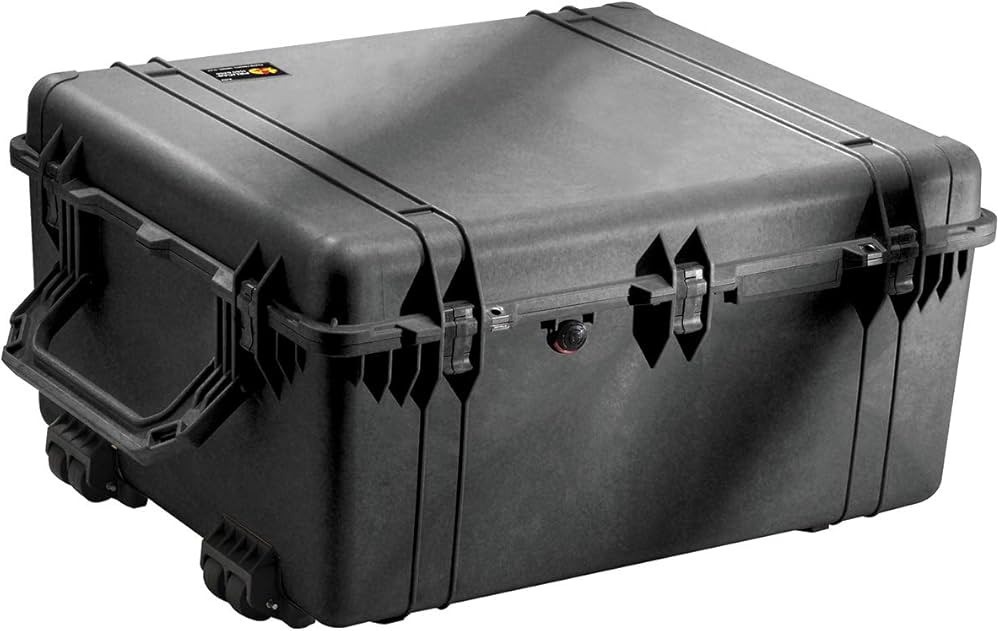 That case was a marvel. It was bullt of virtually bullet-proof plastic, with seven hefty latches around the lid. These clamped shut with a satisfying CLACK, and the edge of the case was cunningly recessed and gasketed to make it air- and water-tight. The seal was so good that a pressure relief valve was fitted, and it was necessary: we live in the mountains, and once the case was sealed with our 2100-foot-altitude air in it, getting it open again at sea level would have been impossible without the valve. The foam pads inside immobilized my gear and made it immune even to the sort of handling airline baggage people can dish out. Fully loaded, it weighed about a hundred pounds; I was not looking forward to dragging it 12,000 miles, through several airports, but there was no way around it.
By mid-December I was set, well in advance of my January departure date. Or so I thought. Two nights before I was due to leave, my wife and I were talking about her plans. She was to join me at the end of my stay, so she would have to get her own visa. I wanted to show her what the visa looked like; so I pulled my passport out. Opening it to the visa page, I read the information to her, and realized only then, with a sickening jolt, that Dr Saxena's office had issued me a tourist visa.
The Fulbright documents were quite specific that I had to have an entry visa, because I was going there to work. I saw all my planning and preparations going up in smoke, and my imagination wasn't up to the task of picturing the scene when I showed up at the airport in New Delhi with $5000 worth of computer gear and the wrong visa. I was sure that someone was going to make a fair amount of noise about it.
At that time it was about midnight in Blacksburg. I immediately called the Fulbright Office in India to alert them to the situation and to ask their advice. The exact words spoken by the lady in charge of Fellows when I told her what had happened (after ten seconds of shocked silence) were, "Oh, my God." She said she'd have to make some phone calls, as this situation was unprecendented in her experience. I gave her my home phone number and sat tight. About an hour later she called me; and said "I've been speaking to the Government of India. Just come. What they told me was that as soon as you land I should write them a long letter. Just come, we will straighten it out here." She was adamant, though, that I could NOT teach on a tourist visa, and it would have to be "adjusted" after my arrival.
As a matter of record, I was never issued the correct visa. I assume that somewhere in the caverns of the Indian bureacracy's paperwork vault is a letter explaining the situation, but technically I spent my entire time in Karnataka as a tourist.
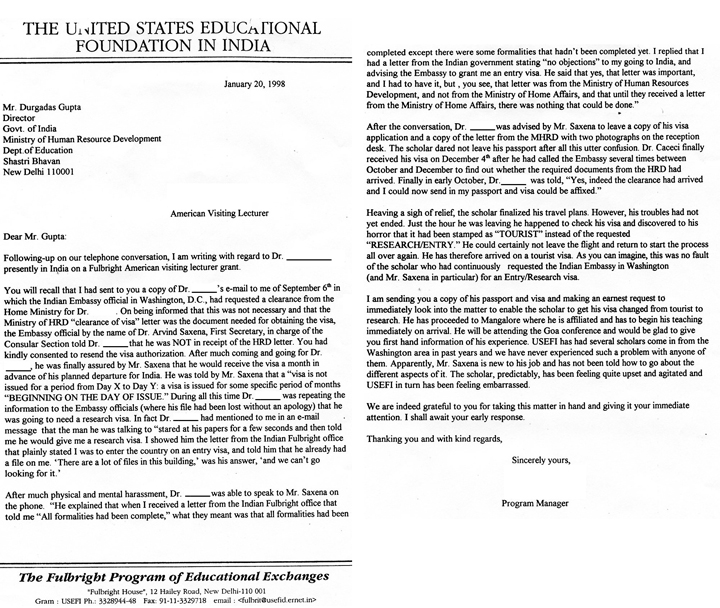
Below is the letter the lady in Delhi wrote on my behalf:
* This was clear proof of my addled state of mind. Why I was worried about the USPS, when I was going to turn it over to the Indians?
**In point of fact I never saw a copy of the letter from MHA that was supposedly needed and which presumably had sent to Dr Saxena—if it ever existed!
| OPENING PAGE|
|SEASON LOGS |
| HUNTING | GUNS | DOGS |
| FISHING & BOATING | TRIP REPORTS | MISCELLANEOUS ESSAYS |
| CONTRIBUTIONS FROM OTHER WRITERS|
| RECIPES |POLITICS |